
Ten years after leaving, the school dining hall was just the same: high windows, polished tables, and the shelves that bore the silverware won by each house: Bewick—my House—Collingwood, Stephenson and Grey. After the school reunion meal, there was a lot of fuss as we wandered the hall, squinting at the honours boards, pointing out our younger selves in old team photos, and tracing faded names on silver cups and shields. I had just won one prize at the Newton Hall Prep-school in five years—the McCracken Gardening Cup, 1974.
My garden plot had been about the size of a double bed. None of them was any bigger. Some boys had grown radishes and lettuce. I grew flowers. A path of crazy paving ran down the centre, and at one end, I made a rockery from the pieces of stone of the old potting shed.
That summer, the school reunion, 1984, the sun had fallen low and late into the evenings, and it was still light enough to wander the grounds after tea. The gardens now were just a slope of grass, blank as a page. The Victorian greenhouse was gone. In its place, an all-weather tennis court—anonymous, hard, and unforgiving.
In 1974, I was 10. It was a funny year—a challenging year, in some ways. There was the miners’ strike, the three-day week and power cuts. At school, that meant hurricane lamps in the common rooms, no prep, and storytelling instead. Early bedtimes. And ghost stories- if your DC could think of one.
There were three of us—Bugs, Pills and me. We had beds in the same dorm, Beamish, and, that summer term, we got a den together. That first Sunday of the Summer Term —April 21st—we were let out into the woods after lunch in birthday order— an arbitrary system. Pills was the 3rd of the month, Bugs the 7th. I, unlucky with my birthday on the 27th, was always near the end. By the time I got out, they’d already staked our claim—dry ground near the nature reserve, good wood scattered about: long branches, some old planks, sacks and fertiliser bags—the ruins of a trench and a bear pit from last term’s battles.
As we cleared the wreckage, we found her.
Curled up under the fallen door. Silent. Watching.
She looked our age—ten—but smaller, thinner. Her hair was matted, and her fingernails rimmed with dirt. She coughed like someone had stuffed a crisp bag down her throat. At first, she said nothing. Then Pills offered her a Toffo, and she took it.
That was how it began.
We quickly learnt that she didn’t want to be found. That much was clear. When we talked of telling someone, she became fierce, her voice low and urgent. She told us, in exacting detail, why she couldn’t go back, why she mustn’t be found, and why it would be best for everyone—especially us—if she stayed hidden. Her name was Lulu, short for Lucinda. She came from Felton Hall, the children’s home just beyond the woods. We felt the weight of her words, the responsibility she had placed on us.
We used to shout “Fellers!” when we saw them. They shouted “Wankers!” back at us.
She claimed the den was hers. She’d got there first. We told her that didn’t count—she wasn’t at the school. Bugs said that being a girl didn’t count either. That infuriated her. She won the argument, and she smiled.
When the outside bell rang for tea, she wanted to come. We had to remind her that she didn’t want to be found. A girl would stick out like a beach ball in a game of rugger.
“Then can I have some?” she asked.
We came back twenty minutes later with cake. We couldn’t smuggle a mug of tea away from Matron’s trolley, but we tried.
Lulu knew the woods. She said the Stelling kids came in during the holidays. They knew where the dens were, the best trees to climb, and where to find wild garlic in spring.
We didn’t go into the woods to see Lulu every day. Not on Mondays, Tuesdays, Thursdays, or Fridays—those were Games or Classroom Days. But we assumed Lulu would be all right. The woods took care of things. That’s what we thought.
One day, we had a science project on convection currents. We were sent to study the outdoor swimming pool and found a rabbit floating there, sodden and still. Mr Byers said Chuck it in the incinerator. We insisted on burying it—behind Hedley’s vegetable patch. Bugs said it might want something to nibble if it returned as a ghost.
That night, I lay awake, staring at the ceiling. I thought about what happened when things died. My grandparents had been cremated. Our goldfish went down the waste disposal. What would happen if Lulu died?
Morning break meant a compulsory walk down the school drive—bright clothes hidden beneath boiler suits. Deviation risked a caning. Even so, I snuck off. Three strokes on the backside were worth it. I found Lulu asleep beside the fire. Damp socks, earth, and biscuits. That was the smell. We were defying the school rules, but the thrill of our rebellion was nothing compared to the comfort we found in Lulu’s company.
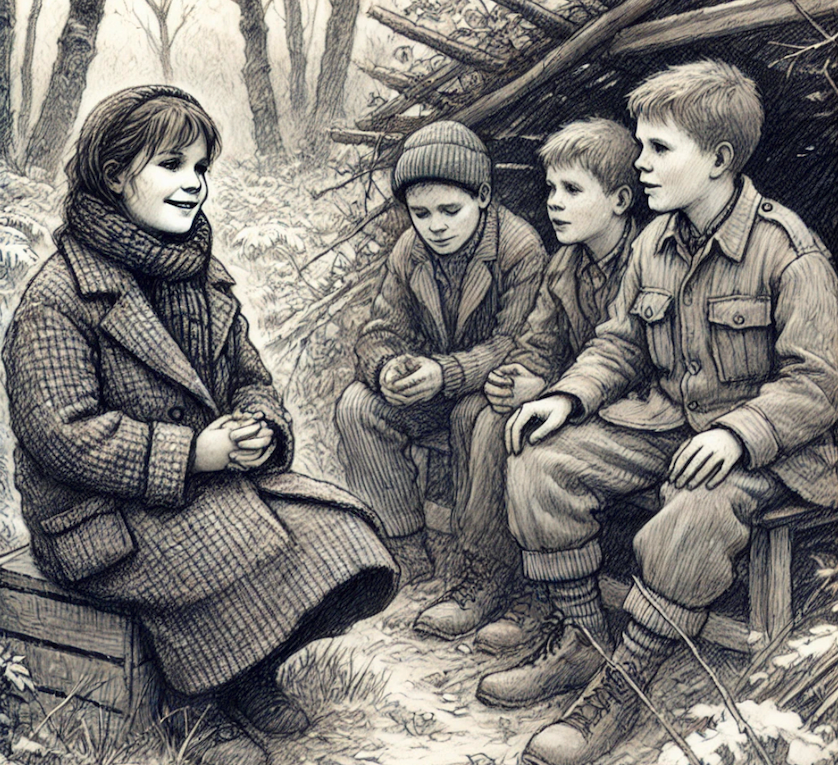
We took turns going into the woods to look in on Lulu. When we could get a way and not get caught. On Thursdays, we had double art with Miss Hillbury. Sometimes, we’d be “in the field,” drawing the boathouse or the greenhouse. “How about drawing the big beech pollard in the woods?” we’d suggest, and when the teacher wasn’t looking, we’d go off to find Lulu. On Fridays, there was choir practice. Pills and I were sopranos. The choirmaster never learned our names. He thought we were the same boy, so we took turns to disappear. Our bond with Lulu grew stronger, and we cherished these stolen moments with her.
Saturday was match day. Bugs and I played for the Colts XI. Parents came. The place bustled. Pills was free to slip away.
We scavenged: half a banana, an old Lucozade bottle for water, condensed milk, socks, cake and books from the library. Asterix the Gaul was her favourite, even though it was in French.
Lulu said her mum had been locked up. Her nan couldn’t take her. The stepdad wanted her, but she refused. Stelling was supposed to be temporary. “It wasn’t,” she said.
Her cough never went away. One night, I took her a rug. It was easier than I thought—down the back stairs, into wellies, out the door.
Sometimes, she talked—not much, but enough. Bugs gave her his Look and Learn magazine. Pills brought a Donny Osmond poster he pinched from his sister. I got cake and Vicks.
“I like you,” she told us once. “You’re kind.”
We didn’t feel kind. We felt like grown-ups—her life in our hands.
Then, she started sleeping more and smiling less. She stopped eating the cake and drinking the tea.
“I think we need to tell someone,” Bugs said one Sunday after lunch.
“No,” I said. “She doesn’t want that.”
“She could die, Barnie.”
Pills looked at me. “Maybe she’s already dying.”
I wanted to hit them. I didn’t. “We made a promise.”
We nodded. Idiots, all of us.
The day she died was warm—a proper spring day. Every teacher thought it would be an original idea to have lessons outside. Art was drawing trees in the woods.
“You’re not allowed in our woods!” we pleaded. “No adults allowed!”
Miss Hillbury laughed but stopped at the edge of the woods. “Fifteen minutes. Bring back your first sketch.”
Pills, like a fool, drew Lulu sleeping in our den. He was going to show it to Miss Hillbury. It was a lovely sketch. We stopped him.
Later, the Headmaster gave us a half-day. We raced out.
She was curled up, wrapped in the school blanket, still. Her mouth was slightly open, and one hand rested on a water bottle.
I sat beside her. I didn’t cry. Not then.
Pills took off his crucifix and placed it in her hand.
“She liked it,” he whispered.
Bugs stood a little way off. “We have to bury her.”
We argued. The trench? Too horrid. The incinerator? Too horrendous.
“A grave in the gardens,” Pills suggested.
We didn’t have a plot. But we could get one.
The gardening area buzzed with boys—small beds marked with sticks and names. A few jeered as we approached.
“You’ve left it a bit late,” one said.
“Obviously,” I replied.
A boy with a sieve pointed to a nettled patch under the trees. “No one’s touched it. But it’s yours if you want it.”
We dug. We dug deeper than anyone else. “Two feet at least,” Bugs said, quoting something. “More, for… other reasons.”
When it was ready, we wrapped her in the rug from my bed and laid her down.
I said a prayer—a real one.
And that was that.

Ten years on, standing there once more, I wondered what she would have been like had she lived. We would have just turned 20, with our entire lives ahead of us. I tried to imagine what Lulu would have looked like at 20—that winning smile, her bright eyes, the clothes she would have worn, the music she would have loved, the smart and sometimes ridiculous things she would have said. And I would have laughed.
Surely someone missed her.
I missed her.