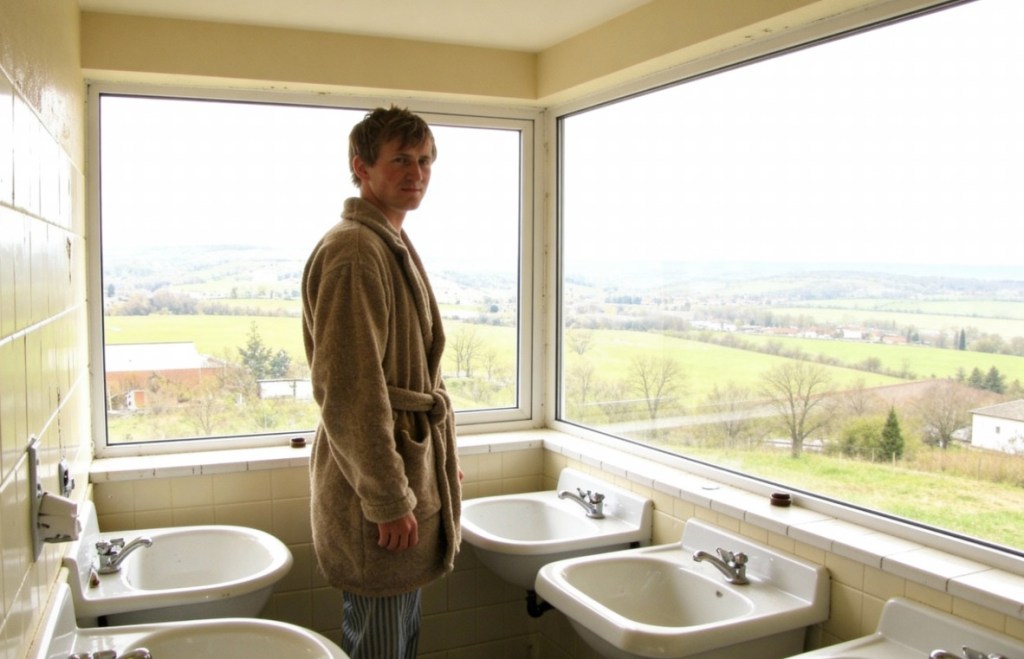
The day began looking north from the washroom windows, several storeys high, from Winder House north to Winder. This was my lighthouse keeper’s view. My window onto the world. For an institution with over sixty boys, it was a marvel that I so often had this view to myself. Did I get here early or late? Very early strikes me as right. In future years, I’d see the Housemaster’s daughter heading off to catch the bus to her school in Kendal. There’d be a note from me in her coat pocket.
Meanwhile, all I had to consider at 7.00 something in the morning was an old woman trundling down the drive with two school trunks balanced precariously in a wheelbarrow. It struck me as odd for several reasons: there are few women involved in our all-male boarding school, unless she is a housemaster’s wife (or daughter), a house matron or the house cook (or kitchen assistant), or, at a push, a teacher’s wife (or daughter), or a parent. But why take two boys’ trunks off down the drive? Maybe it was a burglary? Poor pickings. The trunks were worth more than their contents.
The image remains fixed: two large wooded Isaac Walton trunks, banded and metal-ribbed, inching their way towards the bursar’s house like large jellies on a tray. One wobble away from a fall and spilling open. Perhaps I’d been dreaming. A reality of sorts. I’m just picking out what it says in my diary fifty years on. That’s right. Fifty years, to the day.
It was the last day of term. Most of us headed for Tyneside would be getting our trunks packed and along the drive and into the library car park later that day. Why do the 90 mile return journey by car if you could save the bother and get the lad when he arrived on your doorstep in the evening.
We used a luggage trolley. There were three of them. Not a wheelbarrow.
Breakfast in the dining room meant cornflakes, toast, with eggs and bacon oven-cooked in a sea of cooking oil.
Otherwise it was a ‘normal school’ day as far as it required us to attend morning assembly before being redirected to classes and activities designed to occupy us rather than teach us anything at all.
Someone had decided that slides on architecture would do the job. A young teacher, earnest enough, fiddled with an ancient projector in Powell Hall. The machine threw a white-yellow beam, thick with dust motes, and it clicked shut after each frame like a mechanical contraption of the late 19th century recovered from a science museum.
I was fourteen. Glass Slides, pirates in the gym, a swim not requiring lengths, and shooting: the school was excelling at keeping idle minds out of trouble – or so they thought.
In the gym, we played pirates – a more violent version of the game we’d played at my prep school, Mowden Hall. In this version, being tagged was not enough; each attempt to tag required a scuffle that made wrestling look like a non-contact sport. A knuckle drilled into the spine between the shoulder blades meant you were out – nothing else would do. That or be rugby tackled off the mats: out. My broken leg was no excuse. Broken in March. In plaster until July. I’d missed the entire summer term. I only got rid of a walking stick in September. I had one leg shorter and one foot smaller than the other. I had a limp, so an anonymous new boy, the nickname ‘hopperty’ was adopted. I also wore non-regulation ankle boots with a zip up the side: fancy, but the distinction resulted in an alternative nickname ‘Booties’, which, because I detested it even more than hoppity, stuck.
Still, I played pirates. Five years of rugby, running, obstacle courses, den raids and an outdoor swimming pool meant I was still more agile than boys who were still getting used to being away from mummy and the comforts of home. And when it came to fighting on the gym mats, I had a further advantage – an older brother who’d been wrestling me to the ground and winning since I could remember. When I got into a fight, it was short and decisive precisely because I fought how he did – brutal with short bursts of strength.
Then, swimming: or rather the balcony jump. There was a gallery at one end of the pool, probably not meant for boys to leap from, yet no one ever stopped us. There was never a lifeguard. You put a leg over the balcony, then stood on the other side, and could have dropped straight into the pool. What you needed to do was to fling yourself out and try to reach an overhead light. If someone had smacked the cover off the neon strip light, it would have, in all likelihood, ended up in the pool.
Nets and water polo balls made an appearance. Three aside would make a game. There was a South African lad who decided there was a thrill even greater than scoring a goal – rather, smashing the ball full force towards a junior boy’s head and seeing if he could knock him out. He didn’t. I’d turn my head. I got it in the face. I was wearing a brace. It punctured the gum producing puddles of blood. He laughed. He knew that a ball was better than throwing a punch. His place in the house pecking order was established – no messing!
Half an hour later, I was pressing the butt of a .22 rifle against my face. The rifle range was between the swimming pool and the chapel.
Fifty years on, I can see a pattern. After assembly, everyone got the joys of Le Corbusier on glass slides, then we rotated through activities by House and year group. After the gym and swimming pool we had ‘congregation practice’ then shooting.
Congregation practice was a pitiful bawling, singing in unison after five years in the school choir, reading music and singing in harmony. But nothing would ever again persuade me of the virtues of the choir – or anything that in my estimation was designed only to make a teacher or the school look good rather than provide me with the education I wanted.
Back to the house. Break. More Food. Toast in the pantry, smothered in spoonfuls of Heinz sandwich spread , which tasted like sweetened coleslaw put through a blender.
Then packing. The ritual of emptying a term of school clothes into a trunk: dirty clothes, battered books, school uniforms stiff from overuse. You slid in whatever “non-regulation” items you could smuggle to school—small illicit markers of home—and hoped no prefect or housemaster would take an interest. I had jeans (flares) and a white T-shirt. I hoped that if i’d felt the urge to run off at some point, I’d have civilise to put on so that I’d look like a local. They were put to good use a couple of years later when I went ‘over the wall’ one night to meet up with a girl to go to a local disco. A local lad took a disliking to me and smashed me in the gob. I hadn’t risked fighting back for fear of being ‘found out’ and duly expelled. That was my excuse, that and him being about 6ft 2, in this twenties and built like a truck. Your best disguise would be to leave on all fours as a sheep.
I have a list of my school books for my first term at Sedbergh. History 1603-89, Silas Marner, The Tolpuddle Martyrs, The Tempest, as well as Chemistry, Physics, Latin, French, Geography, Biology, Maths, The Bible and Music Theory. Did these make their way home or stay in a locker at school? Most stayed in a locker. I can see them they crying not to be abandoned. I can’t imagine wanting them at home. For boarders schools started and ended with each term. You dropped that life as you stopped through the reality portal. Not that you even understood what reality was.
Applegarth’s mack surfaced inexplicably among my things. It made its way to School House. The following summer, he went on to play a girl in Salad Days, tennis skirt and all. And decades after that, to lead Northern Rock as their CEO.
The afternoon brought shooting: .22 rifles under the watchful eye of an Ex-Army NCO. We had a .22 and shotguns at home. I’d been shooting at objects, dead and alive, since I was 9 or 10. A crack shot at Bisely, our father had us hitting the bullseye with rifles, and later, the transition seemed the wrong way around, with arrows.
By late afternoon Parents arrived in estate cars to pick up their boy or boys in the House yard. Over in the library car park there was a clatter of trunks as they were dragged over tarmac and lifted into the coffers of private coaches to take entire communities of posh boys north-east to Durham and Newcastle, or south towards Manchester and Leeds.
The journey home wound east to the A66 at Brough, then north from Scotch Corner up the A1.
I may have sat alone, never with my brother. We divided by age cohort. I always enjoyed reading when travelling and never got car sick. Was I thumbing through Jung’s ‘Man and His Symbols’ or ‘The Weather Machine’ by Nigel Calder, a likely September birthday present? Or was I reading Asimov’s Foundation’ or ‘The Omen’? I didn’t say, and fifty years on, I don’t recall.
The A1 wound through Gateshead, over the Tyne Suspension Bridge, dipped through Newcastle, then along by the Town Moor, through Gosforth High street to the Rugby clubs. Streetlights, sodium orange, slid across the bus windows.
We disembarked at Melton Park, where our mother usually picked us up. It took two trips. You don’t get two trunks and two tuck boxes into the back of an Austin Maxi. My brother may have shouldered his trunk and walked. We lived close enough.
Home felt unchanged—which meant dull—soft lamps, silence, routines. Yet you felt the shift in yourself: the slight expanding of the lungs, the loosening of unseen threads. My bedroom was modest: a single bed, a desk, and some shelves—a fitted wardrobe. The guest room with twin beds and a view of the drive and rookery remained just that. When we were younger boys, my brother and I shared it. In my later teens, I’d move in here and replace the single beds with a double. But these times are a few years away. I’ve got a lot of growing up and growing to do first.
We stuffed ourselves with marmalade on toast or perhaps ginger snaps, opened a backlog of Advent calendar windows—nineteen at once—and stayed up late watching whatever three channels of TV had to offer.
I soaked in a Badedas Bath.
And as I fell asleep, I felt something like contentment, something like boredom, something like relief. Whatever tomorrow had to offer, it wouldn’t be like today. There was a Christmas tree to nail to a stand.
Leave a Reply